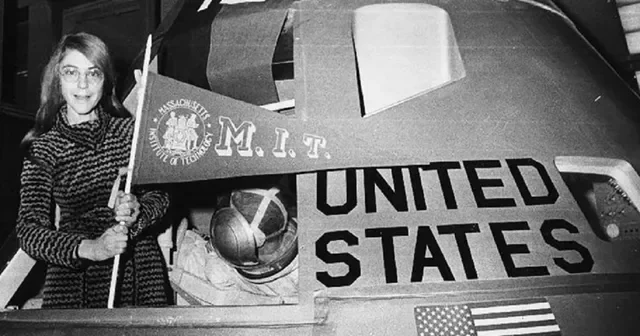
She and her team at MIT were tasked with designing the onboard flight software for the Lunar Module (LEM) and the command module.
This was a crucial mission: this software had to be absolutely perfect, as the lives of the astronauts depended on it. The computer scientist and her team worked with rigor and precision, anticipating all possible scenarios, even the most improbable.
The Famous Bug 1202
Just before the Apollo 11 landing, as the lunar module was minutes away from the Moon's surface, an unexpected alarm went off: alarm 1202.
Thanks to the error detection system designed by Margaret Hamilton and her team, the onboard computer was able to identify a problem: the rendezvous radar, which was not necessary for landing, was sending too much data to the computer. This risked overloading the system and causing a crash.
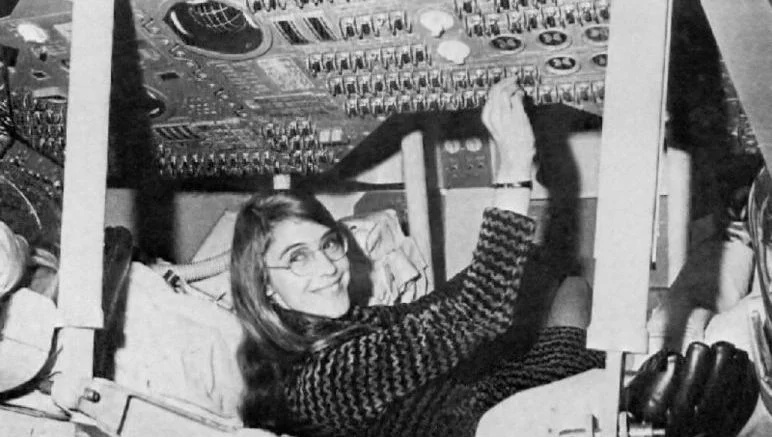
Margaret Hamilton during the Apollo program. - NASA
Cependant le logiciel de Margaret était intelligent. Il était conçu pour donner la priorité aux tâches les plus importantes, comme l’alunissage. Face à la surcharge, il a automatiquement mis de côté les tâches moins critiques (celles du radar de rendez-vous) pour se concentrer sur l’essentiel. C’est ce qu’on appelle une programmation asynchrone et une gestion des erreurs très avancée pour l’époque.
Le contrôleur de vol, Steve Bales, a fait confiance au logiciel et a donné le feu vert pour la poursuite de l’alunissage. Quelques instants plus tard, Neil Armstrong et Buzz Aldrin se posaient sur la Lune. Sans la prévoyance et la rigueur de Margaret Hamilton et de son équipe, la mission Apollo 11 aurait pu échouer. Son travail a été absolument fondamental pour ce succès historique.